
CHG Issue #235: Testing Boundaries
The market is testing the Fed’s reaction function, Japan’s tolerance for yen weakness, and Silicon Valley’s ability to size its own conviction

Last week gave us three new pieces of information.
The Fed held rates steady, but the yield curve steepened. Japan, India, and the US intervened in the FX markets to weaken the dollar. And one of the most important AI funds in the world blew up after helping set the marginal price in one of the year’s biggest market stories.
The market is not a single story. It is an auction. Price advertises opportunity, time regulates that opportunity, and volume tells us whether anyone is willing to accept it. Every week the market shows us where real money is flowing, where policymakers are drawing lines, and where narratives are strong enough to survive contact with reality.
Last week the market pushed the system far enough to expose its fault lines.
It showed us that the Fed is no longer the only institution setting financial conditions. It showed us that Japan is no longer a passive denominator in the dollar-yen exchange rate. And it showed us that some of the most confident AI narratives of the year may have been priced by the weakest hands.
This does not mean our framework was wrong. It means the framework needs to be marked to market.
That is the discipline. We are not trying to defend a thesis. We are trying to understand the system.
The New Framework
Our New Framework begins with a simple observation: the world that existed from roughly 1980 to 2020 was a historical exception.
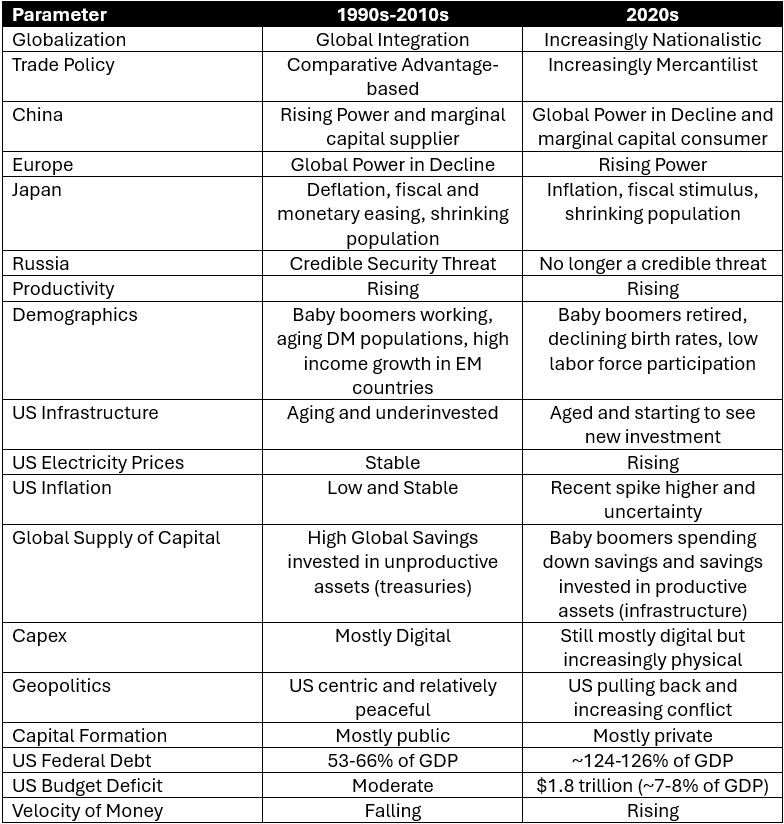
For forty years, the global economy was organized around disinflationary abundance. China entered the global trading system. The Berlin Wall fell. Labor became globally available. Supply chains became cheaper and more efficient. Energy was relatively abundant. Interest rates fell. Global savings were high. New technologies scaled without needing much physical capital. And financial markets learned to capitalize growth far into the future because the cost of capital kept falling.
That world created the present we are living in today.
Governments could borrow more without immediately crowding out private investment. Companies could grow without carrying much inventory or physical infrastructure. Consumers could buy cheaper goods from all over the world. Central banks could absorb volatility because inflation was usually falling back toward target. Asset prices could rise because each future dollar of earnings was discounted at lower and lower rates.
The whole system worked because the world kept supplying more labor, more goods, more savings, more energy, and more institutional trust at prices that kept falling or at least remained stable.
The New Framework asks whether that world is ending.
Not because everything is collapsing. Not because America is finished. Not because globalization disappears overnight. The question is more subtle than that. The old disinflationary forces are weakening at the same time that new capital demands are rising.
AI is digital in output, but physical in input. It needs chips, data centers, electricity, cooling, land, transmission, and capital. Reshoring and friendshoring may make the system more resilient, but they require redundant capacity, inventories, factories, ports, warehouses, minerals, and skilled labor. National security policy is organized around internal constraints instead of exporting democratic values through trade. Aging societies need more healthcare and elder care while producing fewer workers and possibly fewer savers. Fiscal deficits need financing. Defense production needs financing. Energy security needs financing.
The old world asked capital to fund software and globalization.
The new world is asking capital to fund AI, deficits, defense, grids, energy, reshoring, friendshoring, and aging societies all at the same time.
That does not mean rates only go up. This is not a cartoon. Recessions still happen. Growth scares still happen. Technology can still be deflationary. AI may yet produce enough productivity to justify the buildout. But the old stable disinflationary channel is less reliable than it used to be.
So, the framework is not “higher rates forever.” It is that the clearing price of capital is becoming more volatile because the system is asking more of capital than it did in the last regime and the institutions that once managed the system are increasingly yielding to free but mercurial markets.
Last week updated that framework in three places: the curve, the dollar, and AI.
The Fed Did Not Have To Hike
The Fed held rates steady last week, but the market thinks Warsh should be tightening.
That is a reasonable first read. Inflation is still too high. The Fed had three dissents in favor of a hike. Warsh is a new Fed chair, and markets always test a new Fed chair. That is human nature. If there is a new sheriff, the town wants to know whether he is going to enforce the law.
But the curve gave us the deeper read: long-term rates rose while short-term rates fell.
If the market simply thought the Fed should be hiking, why did the part of the curve most tied to Fed policy go down?
The better answer is that the market did the Fed’s job for it. The Fed held rates steady, but the market tightened financial conditions through the long end. The front end priced a bit more probability of future easing or weaker growth, while the long end priced more term premium, inflation risk, supply risk, credibility risk, or some combination of all four.
That is not a simple hawkish reaction. It is a steepener.
And a steepener is exactly where the New Framework has been pointing.
Warsh wants to make Trump happy by lowering rates, or at least by creating room to lower rates. But he cannot simply cut into an inflation problem and pretend there are no consequences. The market will not allow that. The long end will demand a price.
This is why the old way of talking about the Fed is becoming less useful. We keep asking whether the Fed is hiking or cutting, but the real question is how the Fed is balancing the burden of financing the system.
The Fed can keep front-end liquidity easier while letting the long end carry more of the restraint. It can maintain ample reserves while allowing private markets to absorb more duration. It can support bank lending with a steeper curve while still trying to avoid an inflationary free-for-all. It can be easier in one part of the system and tighter in another.
That sounds contradictory only if we are using the old map.
Under the old framework, the Fed set the price of money and the rest of the system adjusted. Under the New Framework, the Fed is managing a balance sheet, a Treasury market, a banking system, an inflation problem, a political problem, and a capital formation problem all at once.
Therefore, we should update our probabilities.
The probability of a steeper curve went up last week. The probability that the market is only pricing Fed hikes went down. The probability that term premium and capital absorption are becoming central to the rate story went up.
But a steeper curve can cut both ways.
It is constructive if lower short rates reduce funding pressure, improve bank net interest margins, and allow private credit creation while long rates impose enough discipline to prevent inflation from running away. That is the version Warsh probably wants.
It is destructive if the long end is rising because investors do not trust the Fed. In that version, the market is not helping Warsh. It is disciplining him.
That distinction matters.
The market may have done the Fed’s job last week. Or it may have warned the Fed that it will not do the job for free.
Japan Drew A Line
The second update came from Japan.
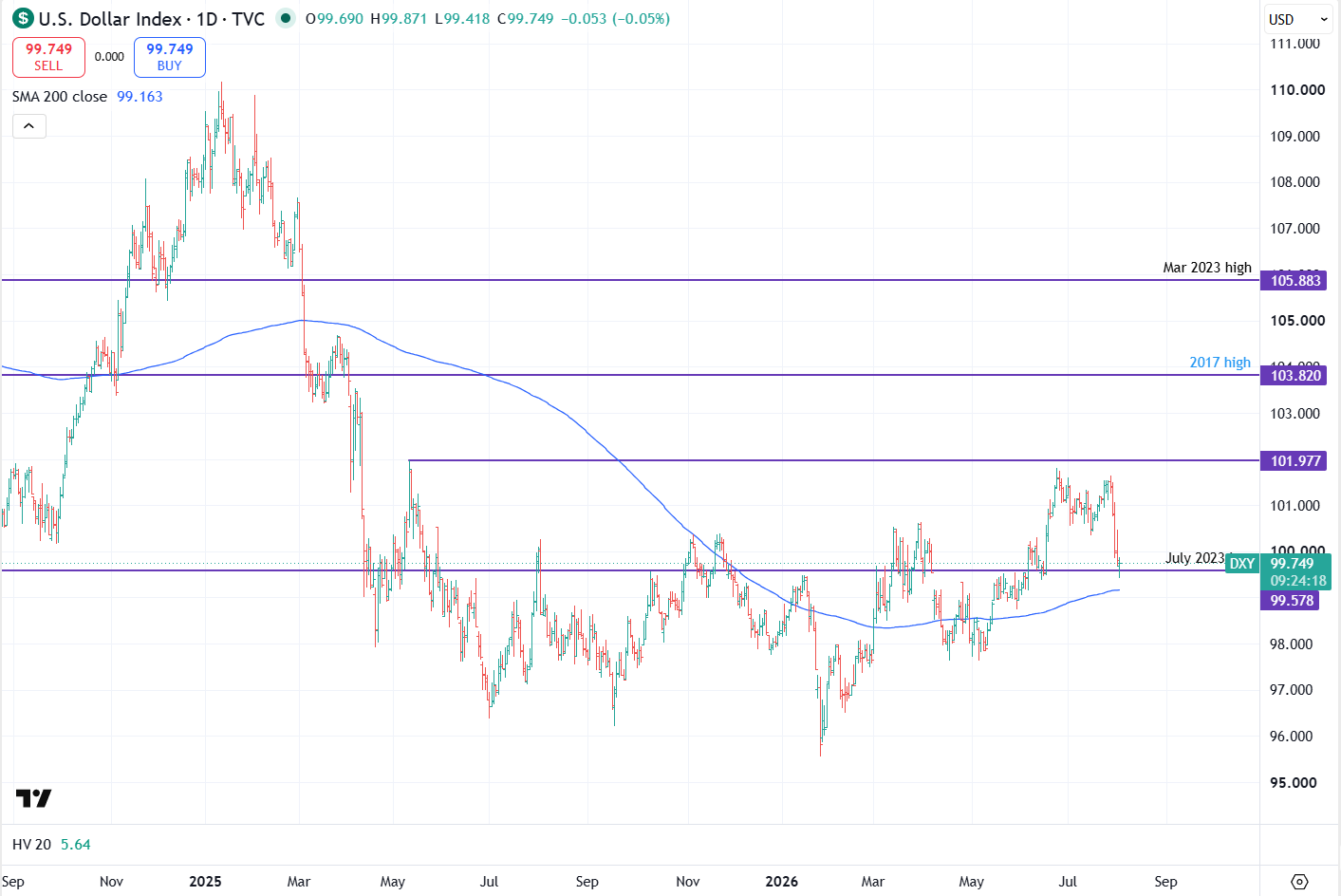
Japan and the US intervened in the FX market to weaken the dollar against the Yen causing a failure at technical resistance. We saw large one-week moves across other currencies pairs as the force of the intervention rippled through the FX markets.
Japan spent decades trying to escape deflation. Now it has inflation, but not the clean kind. It imports most of its energy and much of its food. A weak yen raises household costs. Higher import prices squeeze real wages. Defense spending and industrial policy require financing. JGB yields matter again. And a country that used to tolerate yen weakness as part of the reflation playbook may now find that yen weakness has become politically dangerous.
That is why intervention matters.
It tells us that USDJPY is no longer just a strong US story. It is also the market testing Japan’s tolerance for currency weakness. It is asking how much inflation households can absorb. It is asking how high JGB yields can go. It is asking whether Japan can preserve cheap public financing, currency stability, and strategic fiscal expansion at the same time.
The answer is probably no.
Something has to give.
The intervention also changes the dollar story. The dollar did not simply fail at resistance because the chart looked tired. It failed because a policy actor joined the auction.
That is new information.
It lowers the probability that the dollar breakout was clean and self-sustaining. It reminds the market that the old institutions still have a vote. It also reinforces the broader point that the post-automatic-American world is not a world where the dollar disappears. It is a world where the dollar remains central but other actors become less willing to passively absorb the consequences of dollar strength.
Japan did not end dollar dominance last week.
It reminded us that dominance is not the same thing as unlimited freedom of action.
AI Meets The Position-Sizing Problem
The third update came from Situational Awareness.
Leopold Aschenbrenner’s fund was reportedly up roughly 270% through May, with assets ballooning from an initial $225 million to roughly $25 billion. Then it blew up. Citadel stepped in and bought their portfolio.
They were long the hardware, chip, and infrastructure side of AI and short software. That is almost a perfect expression of the narrative that took hold earlier this year.
Software is getting commoditized. AI is real. Compute is scarce. Chips are the bottleneck. Power matters. Data centers matter. Own the physical layer. Short the old software layer.
That story may still be directionally right.
But the blowup changes how we should read the prior price action.
If a levered fund with enormous AI credibility was helping set the marginal price in these sectors, then the market was not simply discovering the truth about AI. It was also clearing the flow of a concentrated and highly levered balance sheet.
This is not a small distinction.
Markets create narratives after prices move. Hardware outperforms software, and everyone explains why hardware is the scarce asset. Software underperforms, and everyone explains why software margins are going away. The explanations are coherent. They may even be partly true. But if the marginal price setter is concentrated and levered, the price moves first and the explanation arrives second.
That is why “know your competition” matters.
Silicon Valley is very smart. That is not in dispute. But being right about a technological direction is not the same thing as sizing a trade correctly. A correct idea can be a terrible position if it is too large, too levered, too crowded, or too path dependent.
This is the market version of a lesson we have learned over and over again: brilliance does not repeal risk management.
The comparison to LTCM is useful, but only up to a point.
LTCM became a systemic crisis because its positions were embedded throughout the financial system. It was levered, complex, connected to major dealers, and large enough to force a coordinated response. Situational Awareness was large and dramatic, but the market absorbed it. Citadel bought the portfolio. The system bent. It did not break.
That is important information too.
The AI trade had a forced seller, and the market survived.
This is not a simple bearish AI update. It is a market-structure update. It tells us that some of the prior AI pricing was set by weak hands, but it also tells us that the market had enough depth to absorb the unwind.
The more interesting implication is for AI capex.
If the same belief system that sized the Situational Awareness book is also influencing AI capex decisions, then we should raise the probability that Silicon Valley is overspending. Not because AI is fake. Not because the productivity gains will never arrive. But because true believers are usually bad at sizing bets near the peak of their conviction.
That is the risk.
The AI buildout may be real and overbuilt. It may be productive and mispriced. It may be the future and still spend too much money getting there.
Those are not contradictions.
Railroads changed the world and still bankrupted investors. The internet changed the world and still produced a bubble. AI can change the world and still have a capital discipline problem.
Which is why the chart below from Bob Elliott showing computer capex spending’s share of GDP contracting last quarter matters. One quarter does not make a trend. Data can be noisy. AI spending is hard to measure because some of it shows up in software, some in equipment, some in construction, some in imports, and some in future lease obligations.
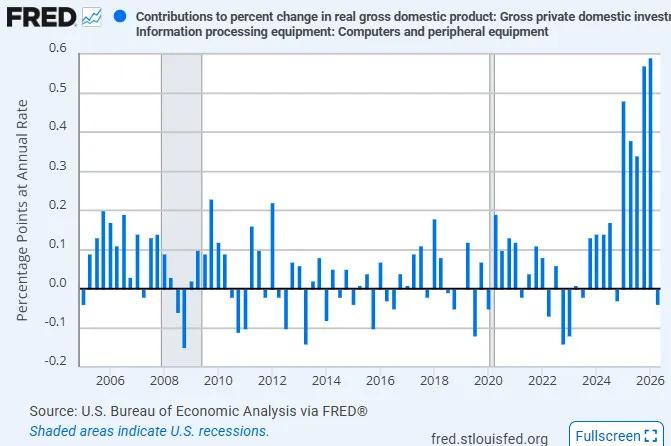
But the chart is now more important than it would have been a month ago.
Before the Situational Awareness blow up, a contraction in computer capex share of GDP might have looked like noise. After the blowup, it becomes a signal to track. If AI capex is already slowing at the same time the marginal AI equity buyer is being liquidated, then the market may be telling us that the first phase of the AI buildout has moved from scarcity to discipline.
What Last Week Tells Us About The System
The common thread here is that the system is trying to find the clearing price of a more capital-intensive future.
The Fed is trying to manage inflation, growth, fiscal absorption, bank lending, and political pressure. The curve is the auction where that balancing act gets priced.
Japan is trying to manage cheap borrowing, currency stability, imported inflation, real wages, and strategic spending. USDJPY is the auction where that balancing act gets priced.
AI companies are racing to build what they believe to be the fountain of youth while balancing the constraints of compute scarcity, power demand, software disruption, investor expectations, and capex discipline. AI equities and credit spreads are the auction where that balancing act gets priced.
This is the New Framework in operation.
The system is no longer organized around one dominant disinflationary force. It is organized around overlapping constraints.
Capital is a constraint. Energy is a constraint. Labor is a constraint. Trust is a constraint. Political tolerance is a constraint. Institutional credibility is a constraint. Physical infrastructure is a constraint.
The market can price those constraints faster than the real economy can resolve them.
That is why this environment feels so strange. Financial markets can immediately capitalize the future, but the physical system still has to build it. The market can decide that AI will transform the economy long before the grid is ready. The market can decide that Japan must stabilize the yen long before Japan has solved its fiscal problem. The market can decide that Warsh can lower short rates long before the Fed has solved inflation.
Prices move first.
Reality follows slowly.
Sometimes the price is right. Sometimes it is too early. Sometimes it is a hallucination with a ticker symbol.
Our job is not to know which one it is in advance. Our job is to keep updating as the system produces new information.
The Fault Lines
The New Framework is useful only if we keep trying to break it.
The first fault line is rates.
If the curve keeps steepening because short rates fall and long rates hold up, the framework is being confirmed. That would tell us the market is separating Fed policy from term premium, liquidity from inflation restraint, and front-end funding from long-end capital absorption.
But if long rates fall because growth breaks, then recession risk is dominating capital scarcity. That would not destroy the framework, but it would change the timing. The future may still be more capital intensive, but the present would be too weak to finance it.
The second fault line is inflation.
The framework expects the old disinflationary channel to be less reliable. That does not mean every inflation print should rise. It means service wages, energy, tariffs, reshoring, defense, and AI inputs should keep creating inflation pressure even when goods disinflation occasionally returns.
If inflation expectations and term premiums fall durably without a recession, the framework is in trouble. That would suggest the system can finance the new capital demands without paying a higher price.
The third fault line is AI productivity.
If AI productivity arrives quickly enough to offset the cost of chips, data centers, electricity, cooling, and labor, then the capex boom may be justified. That would be the disinflationary version of the AI story. It would mean the system paid a large upfront cost and received a larger supply-side expansion in return.
But if capex keeps rising while productivity remains narrow, margins compress, free cash flow falls, and credit markets begin asking harder questions, then AI becomes a capital scarcity amplifier. It may still be revolutionary, but the market will have to reprice who pays for the revolution.
The fourth fault line is Japan.
If the yen stabilizes, wages improve, JGB yields behave, and Japan can fund its strategic ambitions without deeper stress, then the Japan-side constraint is less severe than we think.
But if intervention only buys time, USDJPY resumes rising, and domestic inflation politics worsen, then Japan becomes one of the clearest examples of the New Framework: an aging, import-dependent, high-debt society trying to fund a more strategic state in a world where cheap capital is no longer automatic.
The fifth fault line is institutional trust.
Warsh’s Fed can work if the market believes the new communication style is discipline rather than evasion. Japan’s intervention can work if the market believes policymakers are defending a boundary rather than panicking. AI capex can work if investors believe management teams are allocating capital rather than chasing an arms race.
If trust holds, the system can rebalance.
If trust fails, the same prices become much more dangerous.
That is the big lesson from last week.
The Fed did not have to hike because the market tightened the long end. Japan did not have to wait for an official crisis because it could intervene in the currency market. AI did not have to collapse because Citadel could absorb the forced seller.
The system is still functioning.
But it is functioning by forcing prices to carry more of the burden.
That is what the New Framework expects. The old institutions are not gone, but they no longer absorb stress automatically. The Fed cannot simply guide the market. The dollar cannot simply clear the world without resistance. AI cannot simply capitalize the future without proving that the spending earns a return.
The market is trying to find something to trust by testing the old assumptions.
Like a child testing parental boundaries, it pushed Japan, India, and the US to intervene in the FX markets. It is pushing the Fed with a steeper curve. And it learned that Citadel’s balance sheet was more trustworthy than Silicon Valley’s position sizing.
The new information says the future is still expensive, the system is still adjusting, and the fault lines are becoming easier to see.
Cedars Hill Group is a boutique investment bank built by investors. We invite you to explore our Knowledge Base to learn more about how you can run your business or portfolio like the best.
At CHG, we connect experts, companies, and capital to drive innovation and solve complex problems in today’s fast-paced and rapidly changing financial markets. Get in touch to learn how we can help you navigate your financial future.