
CHG Issue #225: UAExit
the decoupling picks up steam

Iran’s negotiating stance has hardened as IRGC Major General Ahmad Vahidi has consolidated power and endorsed hardline positions on the Strait of Hormuz and Iran’s nuclear program. Despite heavy military and naval losses, the IRGC has been able to assert de-facto control over the Strait which has strengthened its negotiating position. The US imposed the blockade on Iran to starve them out economically but also to gain a bargaining chip that could be used to reopen the Strait. However, the IRGC is demanding the removal of the blockade as a precondition to negotiations which negates that as a potential bargaining chip. This forces the US to bring the IRGC to the negotiating table through other means and hence the announcement of Project Freedom to escort ships through the Strait.
In war, the facts on the ground determine how negotiations will unfold, and currently the IRGC’s strongest lever is its asymmetric threats to ships attempting to transit the Strait. If the US can successfully neutralize these threats through naval escorts, it would meaningfully weaken the IRGC’s negotiating position. On Monday morning, the IRGC has already claimed that it has struck a US warship with two missiles, a report the US has denied.
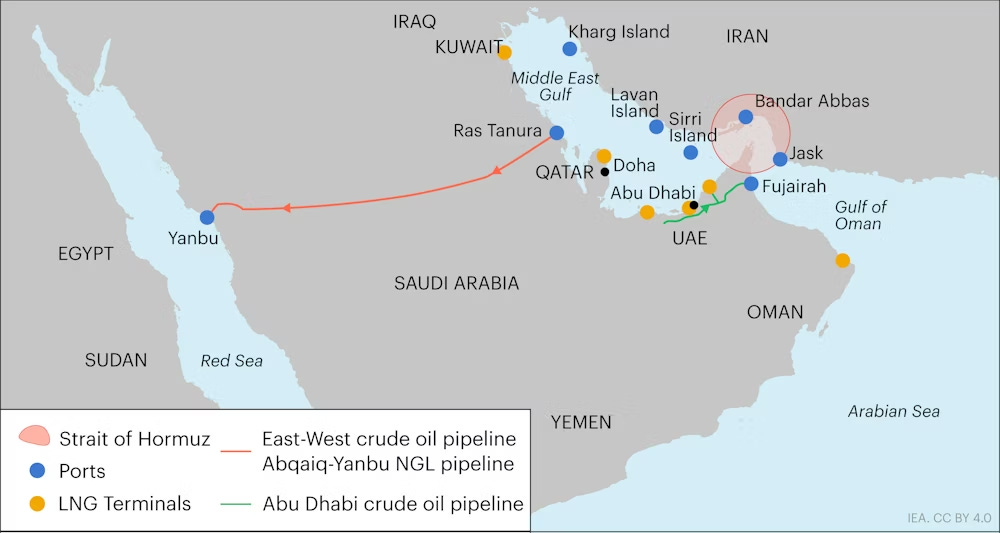
As the situation in the Strait continues to unfold the rest of the world has started to plan for a prolonged closure of the Strait. Saudi Arabia has already been running the East-West pipeline at full capacity, moving roughly 7 Mbpd around the Strait, but to reach the Asian markets where their main customers are they must transit the Bab el-Mandeb Strait where the Houthis regularly threaten naval traffic. This is only a fraction of the 20-21 Mbpd that normally transits the Strait and is constrained by the Houthi threat to the south and Suez limitations to the north.
The UAE is the other large Arab producer with a pipeline that can bypass the Strait, but that pipeline only has a max capacity of 2 Mbpd. As an OPEC member the UAE has consistently produced well below its max capacity of over 5 Mbpd due to production quotas but last week it announced it was leaving the cartel to expand its production and export capacity. The UAE has been looking to do this for a while as the cost of production quotas constrained its economy and now with the world looking at the possibility of a prolonged closure of the Strait their ability to bypass it via the Habshan-Fujairah pipeline and increase production outside of OPEC quotas makes a ton of sense. Given the new regional constraints, it is feasible that the UAE could double the Fujairah capacity within the next four years.
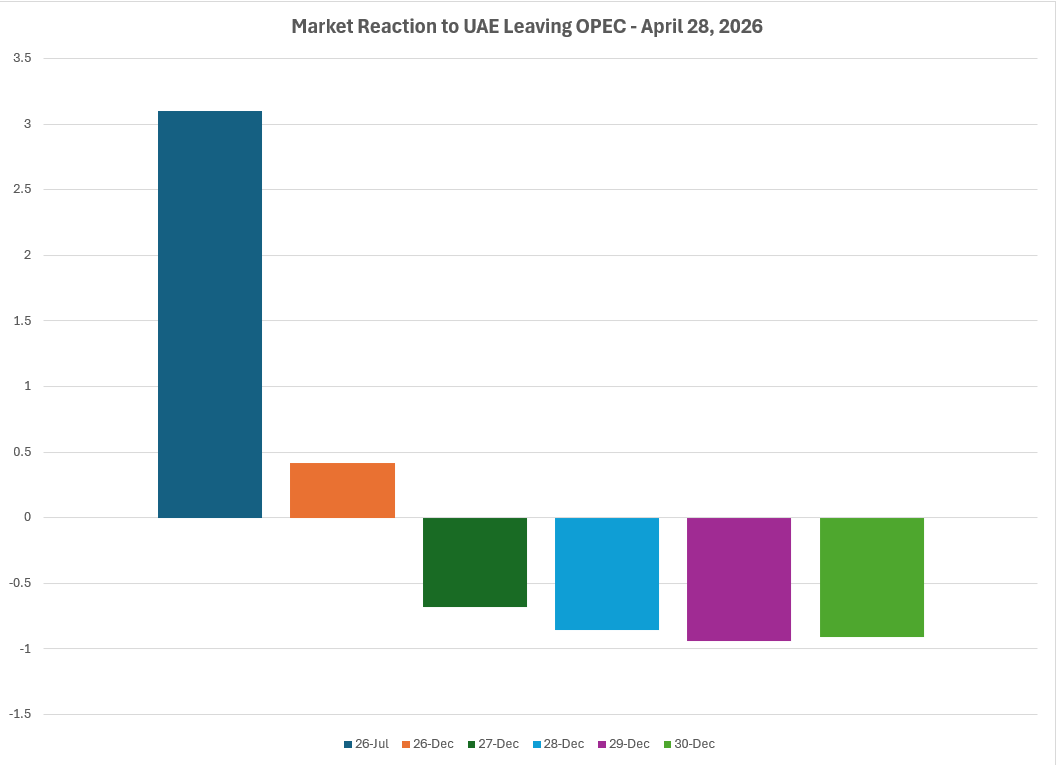
The crude oil futures curve continues in steep backwardation which deepened on the UAE news last week as the market moved to price in higher supply from the UAE by 2030.
This is another brick in the wall of the unfolding institutional crisis that has seen post-WWII institutions that were built around an East-West power balance centered on the Atlantic become increasingly outmoded as the balance of power shifts away from the Atlantic. Brexit in 2016, the Ukraine-Russia war, the slow erosion of NATO influence, US tariffs, the recent NSS, and now UAE are all signs of the decoupling of the global order that was underwritten by US power. Globalization backed by US security guarantees provided freedom of navigation, market access, and low barriers to trade. The incentive was to grow instead of fighting, and the US bore the majority of the cost because it benefitted immensely from this system. However, as rival powers exploited the system, sought to undermine US power, and allies ceased to defend US interests and increasingly criticized US power it was no longer in the US national interest to continue to underwrite globalization. As the dominant global power pulls back, great power rivalries increase, multilateralism recedes, and the focus shifts to regional balances of power middle powers like the UAE are given room to stand up and exert their regional influence.
There is an opportunity for middle powers like India, Turkey, and ASEAN countries to make UAE-like moves to take advantage of the disarray caused by the rebalancing of greater powers. Last week we highlighted the new Japan-Australia alliance and this week we’ve seen another new regional power alliance emerge with Britain announcing a new northern naval force with nine other European countries. Each of these alone is insignificant, but seen together and occurring outside of established institutions such as NATO is significant.
As the US pulls back other countries must consider the need to establish and maintain their own freedom of navigation and market access. This is what the US said to the Europeans at the outset of the Iran War: “you need the Strait more than we do so you need to keep it open while we go in and get the dust.” Europe dithered, and the US put up a blockade. The blockade contains the crisis by establishing a new regional balance and negotiating card with the Iranians. The desired trade is the dust for the blockade; but Iran isn’t willing to play ball yet. By imposing the blockade, the US can postpone the need for a ground invasion while buying time for the Europeans to take responsibility for freedom of navigation in the Strait.
Project Freedom is being described as a defensive action to “rescue” ships stuck in the Persian Gulf. This could create a situation where the US is no longer the aggressor as Iran launches missiles at and executes drone attacks on ships transiting the Strait. This could provide the Europeans with political cover to take action and join the effort to reopen the Strait. This would isolate the IRGC and make their current position even more untenable. Project Freedom alone is probably not enough to reopen the Strait but if it provides allies with the impetus to join the effort to reopen the Strait it could succeed.
The war has moved squarely into the political sphere and the IRGC is settling in for the long haul. The market is only pricing a temporary closure as it sees either the Strait reopening or being bypassed. The longer the US-Iran negotiations take the more we will see producers like the UAE increase production and develop alternatives to Hormuz. Neither the US nor the IRGC have time on their side as US mid-terms loom and the IRGC is crippled, but other nations’ responses will take time. The US is trying to establish a global order where it does not bear the cost and responsibility alone and it is proving to be a very difficult undertaking. We are closely watching the Europeans and middle power countries to see how they respond to these latest moves.
Cedars Hill Group is a boutique investment bank built by investors. We invite you to explore our Knowledge Base to learn more about how you can run your business or portfolio like the best.
At CHG, we connect clients and experts to drive innovation and solve complex problems in today’s fast-paced and rapidly changing financial markets. Get in touch to learn how we can help you navigate your financial future.